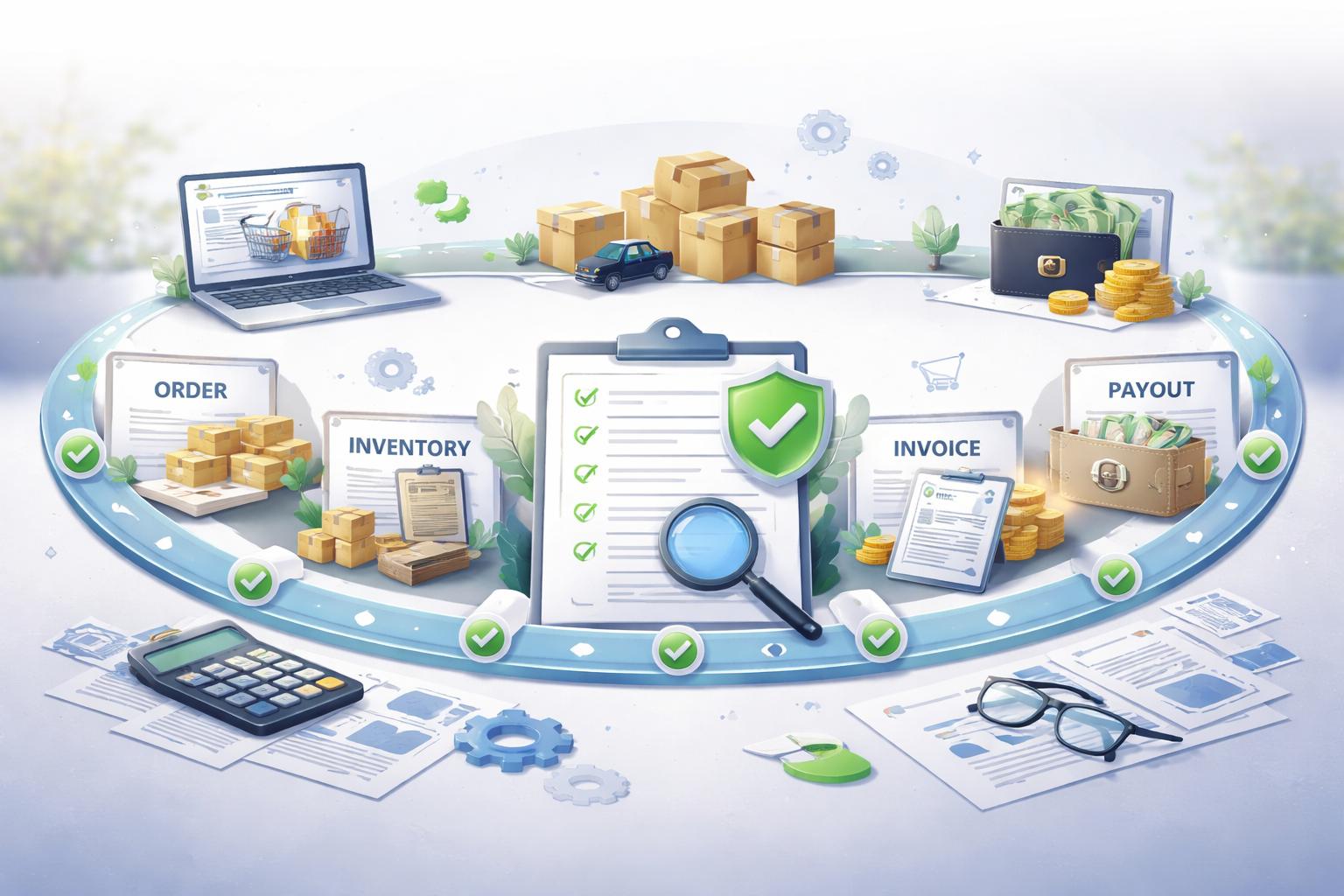
“End-to-end audit trail” is one of those phrases people love in meetings.
It sounds strong.
It sounds controlled.
It sounds like finance, ops, and audit are all sleeping peacefully.
Then someone asks a simple question:
“Can you show me this order from start to finish?”
And suddenly the room becomes very interested in the ceiling.
Because in many businesses, “end-to-end” actually means:
- the order is in one system,
- payment is in another,
- fulfilment is in a courier portal,
- refunds are in email,
- payout is in a marketplace dashboard,
- and accounting is trying to reconstruct the story from exports.
That is not an end-to-end audit trail.
That is a scavenger hunt.
This article explains what a unified order-to-cash audit trail really means, why businesses often think they have one when they do not, and how Malaysian SMEs can build a version that is practical, defensible, and genuinely useful.
We will cover:
- what “order-to-cash” means
- what “end-to-end” actually includes
- the core links an auditor or finance lead expects to see
- where audit trails usually break
- how to build a unified process across channels and systems
- the controls that make the trail trustworthy
Let’s make “end-to-end” mean something real.
What Is “Order-to-Cash”?
Order-to-cash is the full business process from the moment a customer places an order until the business receives and records the money properly.
In simple terms, it covers:
- Order created
- Payment authorised or received
- Order fulfilled / shipped
- Invoice or revenue recorded
- Refund / return / adjustment handled if needed
- Payout or bank receipt received
- Accounting entries completed and reconciled
So when people say “order-to-cash,” they are not talking only about sales. They are talking about the whole financial journey of the transaction.
And when they say “end-to-end audit trail,” they mean you should be able to prove every key step in that journey.
What “End-to-End” Actually Means
A lot of teams think end-to-end means:
“We can find the order in the system.”
That is not enough.
A true end-to-end audit trail means you can trace one transaction all the way through these connected stages:
1. Customer order
What was ordered, when, by whom, and for how much?
2. Payment event
Was payment captured, failed, retried, partially paid, or refunded?
3. Fulfilment event
Was the product shipped, delivered, cancelled, split, or replaced?
4. Financial impact
What revenue, tax, discounts, fees, and refunds were recorded?
5. Cash settlement
What payout or bank receipt came in, and when?
6. Accounting record
Which GL entries represent that transaction, and do they reconcile to source data?
That is what end-to-end means.
It does not mean:
- “ops can see the order”
- “finance has a summary report”
- “customer service can check the refund status”
- “someone can probably pull it if needed”
End-to-end means the pieces connect.
Why Businesses Think They Have It — But Do Not
This is very common.
A business may have:
- Shopify or marketplace order reports
- payment processor reports
- courier tracking
- accounting software
- refund app
- bank statement
So technically, all the information exists.
The problem is that it often does not exist in one traceable chain.
Typical weak setup:
- order ID in Shopify
- payment reference in another system
- courier tracking not linked cleanly
- refund entered manually
- payout batched with many orders
- accounting posted by monthly summary only
That means when someone asks:
“Can you prove what happened to order #12345?”
the team may need to search five systems manually.
That is not unified.
That is fragmented evidence.
The 7 Core Links in a Unified Order-to-Cash Audit Trail
A strong audit trail is really about link quality.
If these seven links are strong, the trail becomes much more defensible.
Link 1: Order ID to Customer Transaction
The first link is the order itself.
You should be able to show:
- order ID
- order date/time
- customer details or customer reference
- items purchased
- quantity
- price
- discount
- shipping
- tax
- order status
This is the commercial starting point.
If you cannot identify the original order cleanly, everything after that becomes harder.
Good evidence
- platform order report
- invoice or order confirmation
- sales transaction export
Link 2: Order ID to Payment Event
Next, you should be able to show whether payment was:
- successful
- pending
- failed
- retried
- cancelled
- partially refunded later
This is where many audit trails weaken, especially with:
- COD
- failed card payments
- subscription renewals
- marketplace settlements
- third-party payment gateways
Good evidence
- payment gateway transaction ID
- payment status report
- captured amount
- payment date
The goal is to prove the order was not just created, but financially progressed.
Link 3: Payment Event to Fulfilment Event
A strong audit trail should show whether the order was:
- fulfilled
- shipped
- delivered
- split into multiple shipments
- cancelled before dispatch
- replaced
This matters because not every paid order becomes fulfilled revenue in the same way or the same period.
Good evidence
- warehouse pick/pack record
- fulfilment status
- courier tracking number
- delivery confirmation
- cancellation note if not fulfilled
This link is also important for preventing fake or premature revenue recognition.
Link 4: Fulfilment Event to Revenue Recognition
This is where finance comes in properly.
The audit trail should make it clear:
- when revenue was recognised
- under what policy
- in what period
- for what amount
This is especially important if your business does not recognise revenue simply when the order is placed.
Good evidence
- revenue recognition policy
- GL posting date
- journal support
- order / fulfilment report used as source
Auditors care a lot about this link because it affects financial statements directly.
Link 5: Order to Refund / Return / Adjustment
Not every order ends neatly.
Some orders involve:
- refund
- return
- store credit
- exchange
- chargeback
- shipping adjustment
- goodwill compensation
A unified trail must show whether the transaction changed after the initial sale.
Good evidence
- refund reference
- return receipt
- reason code
- approval trail
- stock outcome
- accounting reversal entry
If refunds are not clearly linked back to original orders, net sales become much harder to trust.
Link 6: Net Transaction Effect to Payout or Bank Receipt
This is where finance teams often get stuck.
A single order may not equal a single bank deposit.
Especially with:
- Shopify payouts
- Shopee seller balance
- TikTok settlements
- batched marketplace payouts
- bank delays
So the trail must show:
- how the transaction contributed to settlement
- what fees reduced the amount
- when the bank actually received cash
Good evidence
- payout report
- settlement ID
- bank deposit reference
- clearing account reconciliation
This is the point where “sales” becomes “cash.”
Link 7: All of the Above to the General Ledger
Finally, the transaction must be reflected in accounting.
A unified audit trail means the GL is not floating separately from operations.
You should be able to show:
- revenue entry
- refund entry
- fee entry
- payout entry
- clearing account movement
- inventory impact if relevant
Good evidence
- journal listing
- account posting detail
- monthly reconciliation file
- channel clearing account rollforward
This final link is what makes the trail financially useful, not just operationally visible.
What Breaks the “End-to-End” Trail Most Often
Now let’s talk about the real-world weak spots.
1. Different systems use different IDs
Order ID in one system, payment reference in another, warehouse reference in another.
If there is no common linking key, traceability becomes manual.
2. Refunds are tracked separately from original sales
Customer service may process refunds without a strong link back to the original finance record.
3. Payouts are batched and not reconciled properly
This is very common in marketplaces. Without clearing accounts or settlement mapping, cash trail becomes weak.
4. Manual adjustments have no support
Inventory corrections, refund adjustments, and journal fixes without explanation break confidence quickly.
5. Month-end cut-off is inconsistent
Ops uses order date, finance uses payout date, management uses dashboard date. Now the same order tells three different stories.
6. Inventory and finance are disconnected
Returned items may be refunded, but stock may not be restocked, written off, or classified correctly.
7. Too much staff dependency
If one experienced employee is the only one who understands the process, the audit trail is not really controlled. It is just remembered.
What a Unified Audit Trail Looks Like in Practice
Let’s take a simple example.
A customer places an order for RM150 on your Shopify store.
Step 1: Order
Order ID 100987 is created on 5 May.
Step 2: Payment
Payment gateway confirms full payment of RM150.
Step 3: Fulfilment
Warehouse ships on 6 May. Courier tracking number is assigned.
Step 4: Revenue
Finance policy says revenue is recognised on fulfilment.
Journal is posted accordingly.
Step 5: Refund
Customer later receives one damaged item. A RM30 partial refund is approved on 10 May.
Step 6: Payout
Shopify payout batches the net transaction with others and pays the bank on 12 May, after fees.
Step 7: Accounting
GL shows:
- sales revenue
- payment fee
- partial refund
- bank receipt
- Shopify clearing movement
A unified trail means all those steps can be connected back to Order ID 100987 without guessing.
That is what auditors, finance managers, and CFOs mean when they say “end-to-end.”
How to Build a Unified Trail Without Making the Process Horrible
The goal is not to create more admin for the sake of it.
The goal is to make the process:
- traceable
- reviewable
- repeatable
- less dependent on memory
Here is how to do it.
1. Use one common linking key wherever possible
Usually this is:
- order ID
or - a mapped transaction reference
This key should appear in:
- order report
- payment report
- refund record
- reconciliation file
- support documents where possible
2. Use clearing accounts for each major channel
Examples:
- Shopify Clearing
- Shopee Clearing
- TikTok Clearing
These accounts help link:
- sales
- refunds
- fees
- payouts
- bank
Without them, payout trace becomes much harder.
3. Maintain a refund and adjustment register
This should include:
- original order ID
- refund amount
- reason
- approval
- stock action
- accounting reference
This is one of the best ways to strengthen traceability quickly.
4. Standardise monthly report packs
Each month, archive:
- orders report
- refunds report
- payout report
- fee report
- bank statement
- GL extract
- reconciliation workbook
This gives audit support before the audit even starts.
5. Document the cut-off policy
Finance should state clearly:
- when revenue is recognised
- how refunds are treated
- how unsettled payouts are handled
- how timing differences are recorded
This prevents the same transaction being interpreted differently by different people.
6. Require support for manual entries
If a manual journal is posted to:
- clear a variance
- adjust a refund
- fix inventory
- correct a payout difference
it should have proper explanation and approval.
“Correction entry” is not an explanation. It is a warning sign.
Why This Matters Beyond Audit
A unified order-to-cash audit trail is not just for auditors.
It helps management answer:
- Are sales real or just gross order activity?
- Are refunds rising?
- Are fees reducing payout more than expected?
- Is revenue cut-off consistent?
- Can we trust margin by channel?
- Can we explain cash flow properly?
In other words, a strong audit trail improves internal trust too.
And that matters even before any external auditor arrives.
Final Thoughts
“End-to-end” should never mean:
“The data exists somewhere.”
It should mean:
“We can trace one transaction from order to cash to accounting, clearly and consistently.”
That is the real standard.
A unified order-to-cash audit trail requires:
- strong links between systems
- common transaction references
- refund and payout mapping
- clear accounting treatment
- archived support
- controlled manual adjustments
Once those pieces are in place, the process stops being fragile.
And when someone asks:
“Can you show me what happened to this order?”
you do not need to open five tabs, call two departments, and pray.
You can just show it.